Download
Environmental Monitoring
Environmental Monitoring
Environmental Monitoring is the process of systematically collecting and generating primary data about environmental conditions — such as air, water, noise, and soil quality of a target area — to assess, analyze, understand and control the impact of human activities on the environment.
It helps industries, government bodies, and organizations to ensure compliance with environmental regulations, identify pollution sources, and implement corrective actions to protect health, ecosystems, and sustainability.
Why Environment Monitoring?
- ✔To measure pollution levels in air, water, soil and environment surrounding.
- ✔To ensure industries meet environmental standards set by regulatory bodies (like CPCB, SPCB, and MoEFCC).
- ✔To protect human, communities, workers, and the natural environment from harmful pollutants.
- ✔To support data-driven decisions for sustainable development.
How?
Here’s where SKYLAB comes into role. SKYLAB conducts environmental monitoring by using technically & scientifically prepared standard operating procedures (SOPs) prescribed by standards, regulations — below are the Environmental Monitoring services we offer:
- ✔Ambient & Fugitive Air Quality Monitoring
- ✔Stack Emission Monitoring & Analysis
- ✔Water & Wastewater Quality Analysis
- ✔Soil & Solid Waste Sampling and Analysis
- ✔Noise Level Monitoring
- ✔Illumination & Ventilation Surveys
- ✔Vibration Monitoring
- ✔Meteorological Survey
- ✔Personal Exposure
Air Monitoring
Air Monitoring is the process of measuring and analyzing the quality of air in a specific environment to detect the presence and concentration of pollutants. It helps assess the impact of industrial emissions, vehicular pollution, and other sources on human health and the environment.
Regular air monitoring ensures compliance with regulatory standards set by the Central Pollution Control Board (CPCB) and helps industries to take corrective actions to maintain clean and safe air.
Types of Air Monitoring:
- ✔Ambient Air Quality Monitoring
- ✔Stack Emission Monitoring
- ✔Work Environment and Indoor Air Quality Monitoring
Ambient Air Monitoring
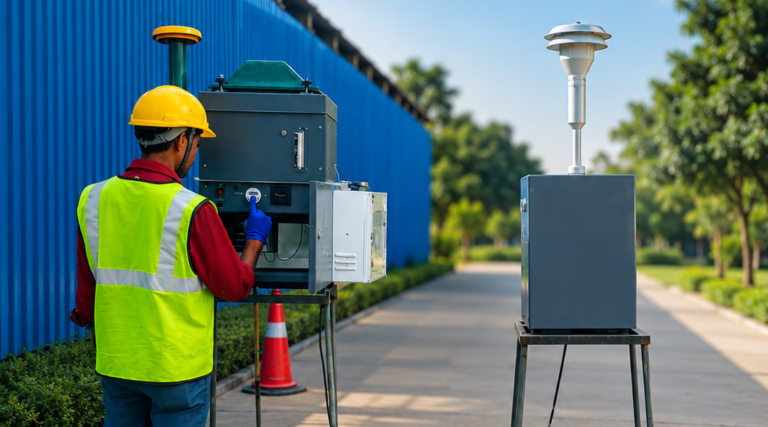
As the name suggests, the process of measuring and analyzing pollutants in the outdoor air. It helps identify pollution sources, evaluate trends, and ensure compliance with national environmental standards.
At SKYLAB, we conduct Ambient Air Monitoring using advanced, calibrated instruments and CPCB-approved methodologies to deliver accurate and reliable results.
What Are the Standards for Ambient Air Monitoring?
Ambient Air Monitoring is carried out as per the National Ambient Air Quality Monitoring Standards (NAAQMS) notified by the Central Pollution Control Board (CPCB) under the Environment (Protection) Act, 1986.
These standards cover 12 key parameters — PM₁₀, PM₂.₅, SO₂, NOx, CO, O₃, NH₃, Pb, Ni, As, Benzene, and BaP — which represent the major pollutants affecting air quality.
Stack Emission Monitoring
Stack Emission Monitoring is the process of measuring pollutants released from stationary source like industrial stacks or chimneys to evaluate compliance with environmental regulations and control air pollution at its source.
It helps industries assess the efficiency of air pollution control (APC) systems and ensures emissions remain within prescribed limits.
At SKYLAB, we conduct Stack Emission Monitoring using advanced instruments such as Flue Gas Analyzers, Stack Monitoring Kits, etc. following standard CPCB and MoEFCC methodologies.
Key parameters typically monitored include:
- ✔Particulate Matter (PM)
- ✔Sulphur Dioxide (SO₂)
- ✔Nitrogen Oxides (NOx)
- ✔Carbon Monoxide (CO)
- ✔Hydro-Carbon (HC)
- ✔Hydrogen Chloride (HCl), Hydrogen Fluoride (HF), VOCs, Ammonia (NH₃) (as applicable)
Work Environment & Indoor Air Quality Monitoring
Work Environment and Indoor Air Quality (IAQ) Monitoring involves assessing the quality of air within workplaces, offices, laboratories, and industrial facilities. It focuses on identifying pollutants such as dust, gases, vapors, microorganisms, and volatile compounds etc. that can affect employee health, productivity, and overall well-being.
At SKYLAB, we conduct detailed IAQ assessments using advanced instruments and methodologies recommended by CPCB, OSHA standards.
Typical Parameters Monitored Include:
- ✔Temperature, Humidity, and Air Velocity
- ✔CO, CO₂, O₃, NH₃, SO₂, NOx, H₂S, VOCs, and Formaldehyde
- ✔Particulate Matter (PM₁₀, PM₂.₅)
- ✔Bacteria, Fungi, and Microbial Count
- ✔Lux/ Illumination and Ventilation Effectiveness
- ✔Ventilation effectiveness – Number of Air changes
Water & Wastewater Quality Analysis
We also provide complete water testing solutions using advanced analytical instruments like UV-Visible Spectrophotometers, AAS, GC, GCMSMS, ICP-OES and TOC Analyzers, following standard methods prescribed by IS, BIS and CPCB.
Types of Water Samples Analyzed:
- ✔Drinking Water (Municipal, RO)
- ✔Packaged Drinking Water
- ✔Ground Water (Wells, Borewells, Tube Wells)
- ✔Surface Water (Rivers, Lakes, Canals, Dams, Reservoirs, Ponds)
- ✔Construction Purpose Water
- ✔Wastewater (Industrial / Domestic)
- ✔ETP Inlet / Outlet Water
- ✔STP Outlet Water
- ✔Swimming Pool Water
What are standards and purpose for testing water?
| Category | Applicable Standards / Guidelines | Notes / Purpose |
|---|---|---|
| Drinking Water (Municipal, RO, Borewell) | IS 10500:2012 (Rev. 2020) | Potability assessment; physical, chemical & microbiological limits. |
| Packaged Drinking Water | IS 14543:2016 – Packaged Drinking Water IS 13428:2005 – Natural Mineral Water |
Applicable for bottled/packaged water units. |
| Ground Water (Wells, Borewells, Tube Wells) | IS 10500:2012 CGWA / CPCB Guidelines |
For drinking water suitability and contamination monitoring. |
| Surface Water (Rivers, Lakes, Canals, Dams, Reservoirs, Ponds) | IS 2296:1982 – Surface Water Classification (A–E) CPCB Water Quality Criteria |
For source water quality, ecology, irrigation classification. |
| Construction Purpose Water | IS 456:2000 – Concrete Work IS 383:2016 – Water impurities limits |
Ensures water is safe for construction and does not affect concrete strength. |
| Wastewater (Industrial / Domestic) | EPA, 1986 – Schedule VI SPCB Consent Conditions (CTE/CTO) |
Mandatory for statutory compliance & discharge monitoring. |
| ETP Inlet / Outlet Water | EPA, 1986 – Schedule VI Industry-specific CPCB/SPCB Norms |
Inlet: pollution load; Outlet: legal discharge compliance. |
| STP Outlet Water | CPCB STP Standards (NGT/AMRUT) EPA, 1986 – General Standards |
For treated sewage discharge from residential/industrial STPs. |
| Swimming Pool Water | IS 3328:1993 – Pool Water Quality | Ensures hygiene, chlorine control, and microbial safety. |
Noise Level Monitoring
Why Noise Monitoring is Important?
- ✔Protect workers from hearing loss & health risks
- ✔Maintain compliance with CPCB, OSHA & Factories Act norms
- ✔Evaluate day–night (Lₙ, Ld) noise levels
- ✔Reduce nuisance and community impact
- ✔Improve workplace productivity & safety practices
Types of Noise Are Covered:
- ✔Ambient noise
- ✔Workplace occupational noise
- ✔DG set noise levels
Soil & Solid Waste Analysis
Why Soil & Solid Waste Analysis is Important?
- ✔Safe land application and disposal
- ✔Compliance with CPCB / SPCB norms
- ✔Identification of heavy metals, organics, and hazardous constituents
- ✔Environmental impact assessments (EIA)
- ✔Sustainable agricultural and industrial practices
What Types of Samples Are Covered?
- ✔Agricultural soil
- ✔Industrial contaminated soil
- ✔Construction site soil
- ✔Municipal solid waste
- ✔Industrial solid waste
- ✔Hazardous waste
- ✔Sludge (ETP/STP)
- ✔Compost / Manure
Vibration Monitoring
Vibration monitoring involves measuring vibration levels (in mm/sec) causes most probably by constructions of building/ Rail/ Metro or any other infrastructure and even caused by machines to detect faults, and ensure compliance with occupational health and safety standards.
SKYLAB has developed a In-house Method for Vibration Monitoring and even got an accreditation for that.
What Types of Vibration Are Monitored?
- ✔Machine vibration
- ✔Ground vibration from piling, blasting & construction activities
Illumination Survey
Why is Illumination Assessment Important?
- ✔Safe working conditions & reduced accidents
- ✔Detection of under-lit or over-lit zones
- ✔Enhanced worker comfort and performance
- ✔Compliance with Factories Act, BIS & OSHA guidelines
- ✔Improved energy efficiency and workplace design
SKYLAB has developed a In-house Method for Illumination Survey and even got an accreditation for that.
Ventilation Survey
Ventilation assessment evaluates airflow, temperature, humidity, and air movement to ensure a healthy, comfortable, and compliant indoor work environment.
Why is Proper Ventilation Important?
- ✔Maintain indoor air quality & worker comfort
- ✔Reduce heat stress and airborne contaminants
- ✔Control odors, fumes & humidity
- ✔Meet Factories Act, ASHRAE & OSHA ventilation requirements
- ✔Improve energy efficiency and HVAC performance
Meteorological Survey
A meteorological survey involves monitoring environmental and climatic parameters at project or industry sites to understand weather patterns and their impact on air dispersion, environmental performance, and regulatory compliance. It is also important to understand the Windrose patterns at designated sites.
What Parameters Are Measured?
- ✔Wind speed
- ✔Wind direction
- ✔Ambient temperature
- ✔Relative humidity
- ✔Atmospheric pressure
- ✔Rainfall
- ✔Solar radiation (if required)
Personal Exposure Monitoring
Personal exposure monitoring measures the concentration of dust, fumes, gases, vapors, and chemicals that workers breathe during their work shift using wearable samplers.
Why is Personal Exposure Monitoring Important?
- ✔Evaluate worker exposure against OEL / PEL / TLV limits
- ✔Identify high-risk activities and areas
- ✔Ensure compliance with Factories Act, OSHA, ACGIH limits
- ✔Plan engineering controls and PPE requirements
- ✔Prevent occupational illnesses and long-term health effects
What type of exposure Are Measured?
- ✔Respirable dust (PM₁₀ / PM₂.₅)
- ✔Fumes (welding, soldering)
- ✔Gases (CO, CO₂, SO₂, NO₂, NH₃, H₂S)
- ✔Chemical vapors (solvents, VOCs)
- ✔Toxic metals (Cr, Pb, Ni, etc.)
- ✔Heat Stress Surveys.
Request a Quote
Share your requirements with SKYLAB’s technical team for Environmental Monitoring services.
Get a QuoteFrequently Asked Questions
What is Environmental Monitoring?
Environmental Monitoring is the process of systematically collecting and generating primary data about environmental conditions — such as air, water, noise, and soil quality of a target area — to assess, analyze, understand and control the impact of human activities on the environment.
Why Environment Monitoring?
Environmental Monitoring helps to measure pollution levels in air, water, soil and environment surrounding. It also helps industries meet environmental standards set by regulatory bodies like CPCB, SPCB, and MoEFCC, protect human, communities, workers, and the natural environment from harmful pollutants, and support data-driven decisions for sustainable development.
What Environmental Monitoring services does SKYLAB offer?
SKYLAB offers Ambient & Fugitive Air Quality Monitoring, Stack Emission Monitoring & Analysis, Water & Wastewater Quality Analysis, Soil & Solid Waste Sampling and Analysis, Noise Level Monitoring, Illumination & Ventilation Surveys, Vibration Monitoring, Meteorological Survey, and Personal Exposure.